MUMBAI
I was born in Bombay and spent nine years of my childhood there, so it belongs to my earliest memories. But that city, at least the one I remember, feels like it no longer exists. In its place is Mumbai: a city of contrasts, chaotic, crowded, anxiety-inducing (for me), and yet somehow still charming. A city I find difficult, but cannot quite detach from.
Bandra has its churches, cafés, old bungalows, sea views, and winding lanes, and cats. So many cats. They appear on steps, windowsills, walls, parked scooters, and quiet corners, looking entirely unbothered and very much in charge of the neighbourhood.

When the Portuguese first built their island fort on a marshy mudflat in the Arabian Sea, I doubt they could ever have imagined what that small stretch of land would become. Over roughly five centuries, Mumbai has grown, merged, expanded, and transformed into a city of incredible scale and energy. Mumbai feels like it is constantly on the edge of collapse. Yet, somehow, it keeps moving, rebuilding, absorbing, and reinventing itself. If you've ever read Terry Pratchett's Discworld series, you may understand why Ankh-Morpork feels suspiciously like Mumbai to me.
This blog draws on several trips we made to the city over the past financial year.

St. Stephen’s Steps in Bandra, where the cool kids come to chill and look effortlessly interesting.
The first time we went to Mumbai in mid-2025 for a 2.5 month stint, Aditya’s company put us up in a small apartment in Andheri East. Apartments in Mumbai are famously small and expensive, but I think I was still holding on to a very different memory of the city. When I was younger and growing up in Mumbai, we lived in Juhu, along a tree-lined boulevard, in a spacious home where we could run freely down long wide corridors and hypothetically, play tennis in the living room. That was the Mumbai I had preserved in my head, so the reality was something of a disappointment.
We were eventually moved to another apartment within Andheri East, and then a third time to Goregaon East. The buildings were packed extremely close together, which meant the lower floors barely got any sunlight. There was very little by way of trees and, during the monsoon, a fair amount of flooding. In one particularly terrifying incident, one of my feet went straight into a flooded sewer-gutter; it took about ten hot showers to wash the horror from my soul.
All of this is to say that Bandra is my favourite neighbourhood! My grandparents lived there for decades and I have fond childhood memories there. It is expensive, and the flats are not exactly palatial (we stayed in a cozy, superbly-located flat off Linking Road, on our last visit), but the neighbourhood is lively, walkable and full of character!

Before it became Veronica’s, with its long queues and very Bandra levels of café enthusiasm, this was Jude Bakery, an old Ranwar village landmark. I remember it for it's fresh bread, tiny counters, busy ovens, and delicious smells. Today, the space has been reimagined, graffitied, and folded into Bandra’s new café culture, although it till retains some of that old charm.

One of my favorite Bandra walks begins at Mount Mary Church, sitting high above the neighbourhood with its twin spires, sea breeze, candles, and old-world drama. From there, you make your way down towards St Stephen’s Steps, where the walls are bright with murals and the staircase seems to function as both public art gallery and unofficial hangout spot. The path then veers into Ranwar and Chimbai, two of Bandra’s old village pockets, where narrow lanes, tiled roofs, old crosses, fishing-community homes, scooters, and small shrines sit alongside cafés, boutiques, and rapidly rising real estate. It's a mix that makes Bandra feel so layered! St Andrew’s Church, one of Mumbai’s oldest churches, adds another quiet historical pause before you head towards Bandstand, with its sea views, joggers and movie-star homes (although most of the traffic seems to be centred around Shah Rukh Khan's Mannat). By the time you reach Carter Road Promenade, Bandra has shown you a little of everything: devotion, graffiti, village life, colonial history, cats, chaos, charm, and the Arabian Sea!

Mount Mary Church’s story goes all the way back to the 1500s, when a small mud oratory stood on its hill. The current church building was completed in 1904. One of the more dramatic stories from its history involves raiders damaging the wooden Our Lady statue in 1700, and, according to the church’s own history, being driven away by a swarm of bees!

No Mumbai walk is complete without encountering the city’s infamous vada pav. It is cheap, filling, delicious, and deeply democratic: eaten by students, office-goers, taxi drivers, movie stars, and anyone else who understands that happiness can cost very little and taste yummy.


St Stephen’s Steps is one of those very Bandra places where the city seems to have painted itself onto the walls. The murals draw from folk art, music, internet culture, everyday street life, history and all the strange little details that make up Mumbai. It's like the walls quietly collect the mood of the city: chaotic, creative, slightly weather-beaten, and full of personality.


There is nothing quite like sitting at Bandstand at sunset, facing the Arabian Sea, surrounded by hundreds of other people doing exactly the same thing.
One moody weekend, our friend Nancy suggested we escape to Sanjay Gandhi National Park for a much-needed hit of nature. The park is one of Mumbai’s most wonderful contradictions: a large tract of forest sitting inside one of the most crowded cities in the world. Its history stretches much further back than the current park itself, with the ancient Kanheri Caves carved into the basalt hills at its heart, once used by Buddhist monks for prayer, study, meditation, and, rather impressively, water storage. The park was earlier known as Krishnagiri and later Borivali National Park, before being renamed Sanjay Gandhi National Park in 1981. Today, it is home to Mumbai’s famous urban leopards, who somehow manage to live alongside the city’s endless noise, traffic, towers, and people.

Sanjay Gandhi National Park: a very comforting reminder that the city still has a wild heart.

In early 2026, whilst once again in the city, we saw that the Bombay Historical Society was running a walk through Dongri and, lo and behold, it was being led by Aditya’s school friend, Vinayak! So naturally, we signed up immediately and I am so glad we did - Vinayak is a great storyteller and it was a wonderful way to spend a Sunday morning!
The name "Dongri" is thought to come from the Marathi word "dongar", meaning hill, a reminder of the older landscape before this part of Bombay became packed with lanes, markets, chawls, homes, shrines, and trading communities. Over time, Dongri became closely linked with nearby Umerkhadi, Bhendi Bazaar, Mandvi, and Mohammed Ali Road, an inner-city world shaped by migration, commerce and faith.


One of its most beautiful landmarks in Dongri is the Moghul Masjid, also known as Masjid-e-Iranian, a Shia mosque built in the mid-19th century by Iranian merchant Haji Muhammad Husayn Shirazi. With its blue tiles, stained glass, Persian-style detailing, minarets, and no dome, it feels like a small piece of Iran tucked into the busy lanes of old Bombay.
It’s impossible to go to Mumbai without spending a great deal of time eating, thinking about where to eat next, and enthusiastically recommending places to eat. The city has a significant buffet of restaurants, with cuisines from all over the world. We also travelled with a friend who has a severe gluten allergy, and were pleasantly surprised by the number of restaurants that were able to cater to this.
One of my long-standing favourites is The Bombay Canteen in Lower Parel, where the food is fun, inventive, and mouth-wateringly delicious. Ask the staff for their recommendations, the menu is full of playful takes on flavours, ingredients, and ideas from across the Indian subcontinent, and the drinks are excellent! Make sure to book in advance though. Mumbai also has its share of pricey celebrity-owned restaurants, like Scarlett House by Malaika Arora in Bandra, which is decorated like a glamorous vampire’s lair in deep reds and velvet. Sadly, we were disappointed with the food. A favourite hangout of ours in Pali Hill was Woodside Inn, small, cosy, and with great vibes. Ayub’s, near Kala Ghoda, is one of those very satisfying South Bombay stops where the food is quick, smoky, spicy, and best eaten without too much ceremony.
To my mind, though, nothing quite beats roadside chaat (dahi-puri is my go-to) in Mumbai (assuming your stomach is feeling brave enough to try it). My favourite breakfasts are bun maska with chai, especially at Irani cafes, and Akuri (Parsi-style scrambled eggs) on toast.
Ayub’s is especially known for its kebab rolls, chicken tikka rolls, seekh kebabs, and baida rotis. A late-night meal with Neha, Sheena and Neha's family, followed by a drive along Marine Drive, really hit the spot.


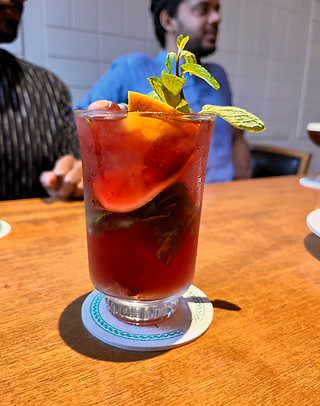
Mumbai restaurants love dressing up their drinks. Over the last few trips I’ve had some very colourful concoctions. The first is a Matcha Fraise Fatale at Blondies Cafe (another fav of ours), the second is The Royal Wedding at Onrique and the last is The Fresh Grape & Mandarin Twist at Woodside Inn.

From Malabar Hill and the Hanging Gardens, South Mumbai looks serene, all sea, skyline, old buildings, and sweeping curves of Marine Drive laid out below. It's a lovely view to catch.


The reason for our last Bombay trip of the year was Lollapalooza, with our friends Ishita and Navneeth. Linkin Park was headlining, so obviously we had to go and relive our late-90s/early-2000s selves.
There is something both ridiculous and wonderful about standing in a field with thousands of other people, all pretending to be composed, and then collectively losing our minds the moment a song from our adolescence begins. It was loud, nostalgic, and slightly surreal.
Somewhere in the middle of the sea of people, my nervous system quietly handed in its resignation. I had to sit down on the floor for a while, and very kindly, everyone around me adjusted as though this was a perfectly normal concert-going strategy.
Bombay is excessive, generous and always awake. Every time I visit, I leave with sore feet, a full stomach, a slightly frayed nervous system, and a long list of places I still haven’t seen or eaten at. Which is probably the city’s greatest trick: it overwhelms you completely, and then somehow makes you want to come back.