DIBANG VALLEY
Remote, rugged, and impossibly beautiful, the Dibang Valley feels like India’s untamed frontier. Nestled deep in Arunachal Pradesh’s wild northeast, it's a place where mountains rise like myths and clouds wander through ancient forests. It’s a land of river songs, tribal warmth, and landscapes that stay with you long after you leave.

It had always been a dream of mine to explore Northeast India. Home to the “Seven Sisters” — Arunachal Pradesh, Assam, Manipur, Meghalaya, Mizoram, Nagaland, and Tripura — along with their “brother,” Sikkim, this region holds an air of intrigue and untouched beauty. A little-explored corner of the world, rich with stories and culture, it had long called to me. When the opportunity arose to travel to Arunachal Pradesh in October 2019, I didn’t hesitate to grab it.
Arunachal Pradesh, often called the Land of the Dawn-Lit Mountains, is the first Indian state to greet the sun each morning. Tucked into the far northeastern corner of the country, it shares borders with Tibet, Bhutan, and Myanmar. In many ways its languages, traditions, and rhythms feel more closely tied to its neighbours than to mainland India. Remote and spectacular, the state is a sweep of lush forests, wild rivers, deep valleys, and extraordinary biodiversity.
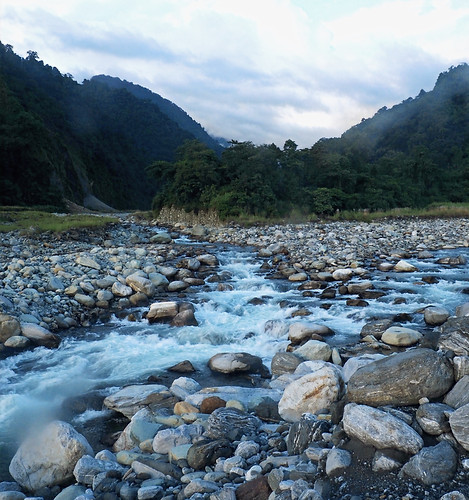
While most travellers make their way to Tawang, our path led us to the Lower Dibang Valley. We flew into Dibrugarh in Assam, via Kolkata, and then began the roughly 145 kilometre drive to Roing in Arunachal, a journey that gently revealed the grandeur of the Eastern Himalayas. Over the following days, we journeyed through the Dibang Valley, named for the fierce and beautiful Dibang River, guided by our hosts from the Idu Mishmi tribe, whose warmth and stories brought the landscape to life.


The Idu Mishmi, along with their brethren, the Digaru-Mishmi and Miju-Mishmi, inhabit the Lohit, Dibang Valley, and Lower Dibang Valley districts. They believe migrated from Tibet centuries ago, bringing with them a Tibeto-Burman language and a way of life closely aligned with the land they now call home. Traditionally, the Idu hold an animist worldview - the belief that every living thing, object, and place possesses a distinct spiritual essence. Their deep bond with nature is rooted in reverence for their creator deities, Nani-Intaya and Masello-Zino, whose gifts shape both their environment and identity.
During our four days in the valley, we learned about their beliefs and rituals, many of which left a lasting impression. One that stayed with me was how the Idu honour the passage of life into death. An Igu (an Idu priest) explained that after someone dies, he performs ceremonies and prayers to guide the soul on its onward journey, for the Idu believe life continues beyond death. The deceased are then buried with their belongings, so they may carry the comforts of their earthly existence into the next world. In one recent instance, he shared, all of a person’s movable possessions, including their bed and cupboard, were laid to rest around them.

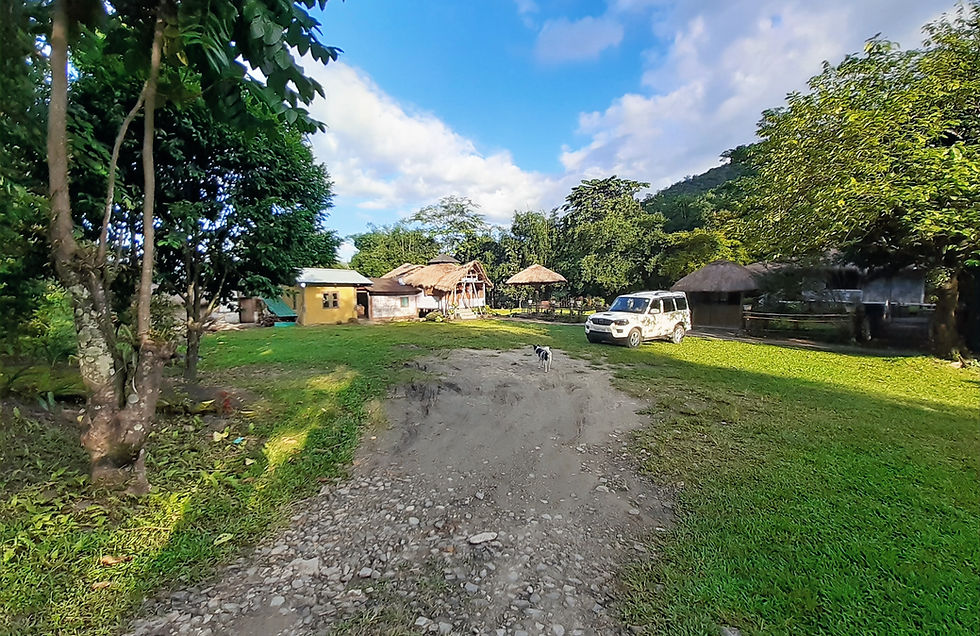
At first light on our very first morning, a chorus of hoots and grunts echoed from the dense forest behind our cottages near Arongo village. Hoolock gibbons! Of the 19 gibbon species found in the world, only two live in India, the Western and Eastern Hoolock gibbons, in small, fragmented forests of eastern Assam and Arunachal. Male and female Western Hoolock gibbons are similar in size, but strikingly different in appearance: the males cloaked in glossy black, the females in soft, brown-blonde fur. Both share expressive white facial markings and an incredible talent for making a lot of noise before breakfast.
Among the Idu Mishmi, hunting gibbons is considered sacrilege; they revere these forest acrobats. As we stepped quietly under the canopy, mist clinging to the mountains around us and birdsong filling the air, our Idu guide explained community efforts to plant trees along railway lines and plantations so that gibbons can once again swing across their broken forest home. And when we finally spotted them, leaping, calling, utterly free, my heart swelled so much I nearly cried. Some moments in the wild do that to you.


The next morning, we set off toward our final destination, Anini, winding our way through the mountains in a well-worn jeep that seemed determined to shed parts as we went. We lost the muffler and then the back bumper within the first hour — neither of which, our driver cheerfully assured us, were essential. The road carried us through the lush greenery of Mayudia Pass and onward to the breathtaking valley of Hunli, sitting at around 5,000 feet (Roing, just under three hours behind us, lies closer to 800 feet). We paused briefly at the local Circuit House for a hot cup of tea, warming our hands and taking in the panorama of mist-draped hills.
As we continued deeper into the valley, the scenery shifted sharply. Towering dams, highways under construction, and skeletal concrete blocks began to dominate the landscape. We passed landslides and stripped hillsides; JCB machines lay twisted at the bottom of ravines, silent casualties of the terrain. Stories followed us like shadows, of migrant labourers who never returned home, villages fractured by relocation, families divided by opportunity and loss. This was “development” in its rawest, most conflicted form.
By late afternoon, we rolled into Etalin, a stunning riverside village bathed in soft mountain light, and living on borrowed time. A mega-dam upstream threatened to submerge it entirely, and negotiations for relocation of people and homes, were already underway. We sat by the river, eating Maggi noodles, boiled eggs, and a delicious vegetable made from freshwater fern, quietly trying to imprint the peace and beauty of this place into memory, before the water and "development" erased it.
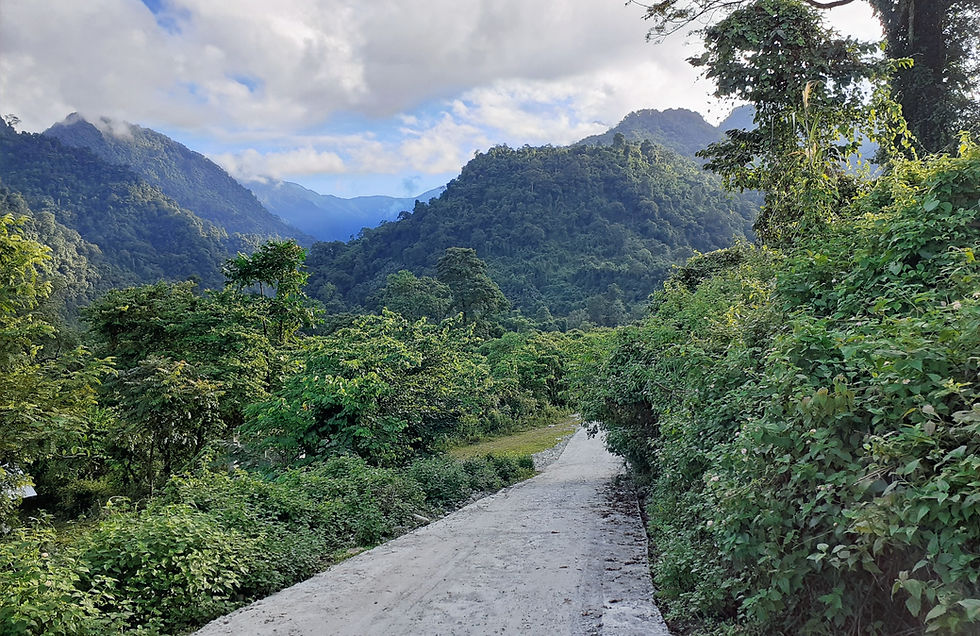

As we resumed our trundle along the winding, muddy road to Anini, we began to hear sharp knocks against the roof of the jeep. At first, the sounds were soft and sporadic, but soon they grew louder, building into a steady, urgent hammering. A landslide was beginning. Stopping wasn’t an option: a deep gorge yawned on one side, a cracking mountainside loomed on the other, mud churned beneath us, and rocks tumbled from above. Our driver, far braver than I felt, navigated the narrow road at breakneck speed, swerving just in time to avoid a large boulder; somewhere in the chaos, we lost the driver’s side mirror.
By dusk, the adrenaline had worn off, leaving us thoroughly drained, equal parts terror and exhilaration. We finally pulled into a tiny highway restaurant and pitched our tents in its tree-lined garden, grateful for solid ground and a night of open sky bereft of falling rocks.
The next morning, after conquering peaks and valleys, splashing across babbling brooks and roaring rivers, and winding through fields and forests that seemed to grow quieter with every kilometre, we reached Anini. Remote and ethereal, the town rests high in the mountains, often wrapped in drifting clouds. We were welcomed with open arms by our hosts, the local Igu and his wife, who immediately made us feel at home by putting us to work peeling potatoes and onions.
Our days in Anini were nothing short of magical. We wandered through towering bamboo groves, scrambled up mossy hillsides, tasted unfamiliar and delicious mountain fruits and vegetables, and dipped our toes into streams so icy they made us gasp and laugh aloud. The forests above Anini are said to be the realm of the Yeti, a guardian spirit of the wild, the animals, and the sacred places. Standing beneath the ancient trees, with mist curling around their trunks and silence settling like a spell, it didn’t feel hard to believe. In the quiet beauty of Anini, the mythical feels entirely possible, and the place leaves you changed, even if just a little.


Our journey back to Roing followed the same rugged route we had taken on the way up, but the mountains had one more heartwarming experience in store for us. Caught in a fierce downpour, we sought refuge in the home of an elderly couple who welcomed us without hesitation. We slept in our sleeping bags around their crackling hearth, grateful for warmth and kindness in the middle of the storm. At 5 AM, they cheerfully woke us with a round of extraordinarily potent rice wine, which our driver wisely declined, before sending us on our way.
Sometime along the road, the front passenger window gave up on rolling back up, and we continued with wind and rain in our faces, tickled at the chaos of it all.
Short though it was, this trip was the most beautiful introduction to Arunachal Pradesh and Northeast India. It was a privilege to be welcomed by the Idu Mishmi, to glimpse their culture, and to witness the wild splendour of Dibang Valley. I know I’ll be returning, there is so much more to learn from this land, its people, and its wonderful nature.